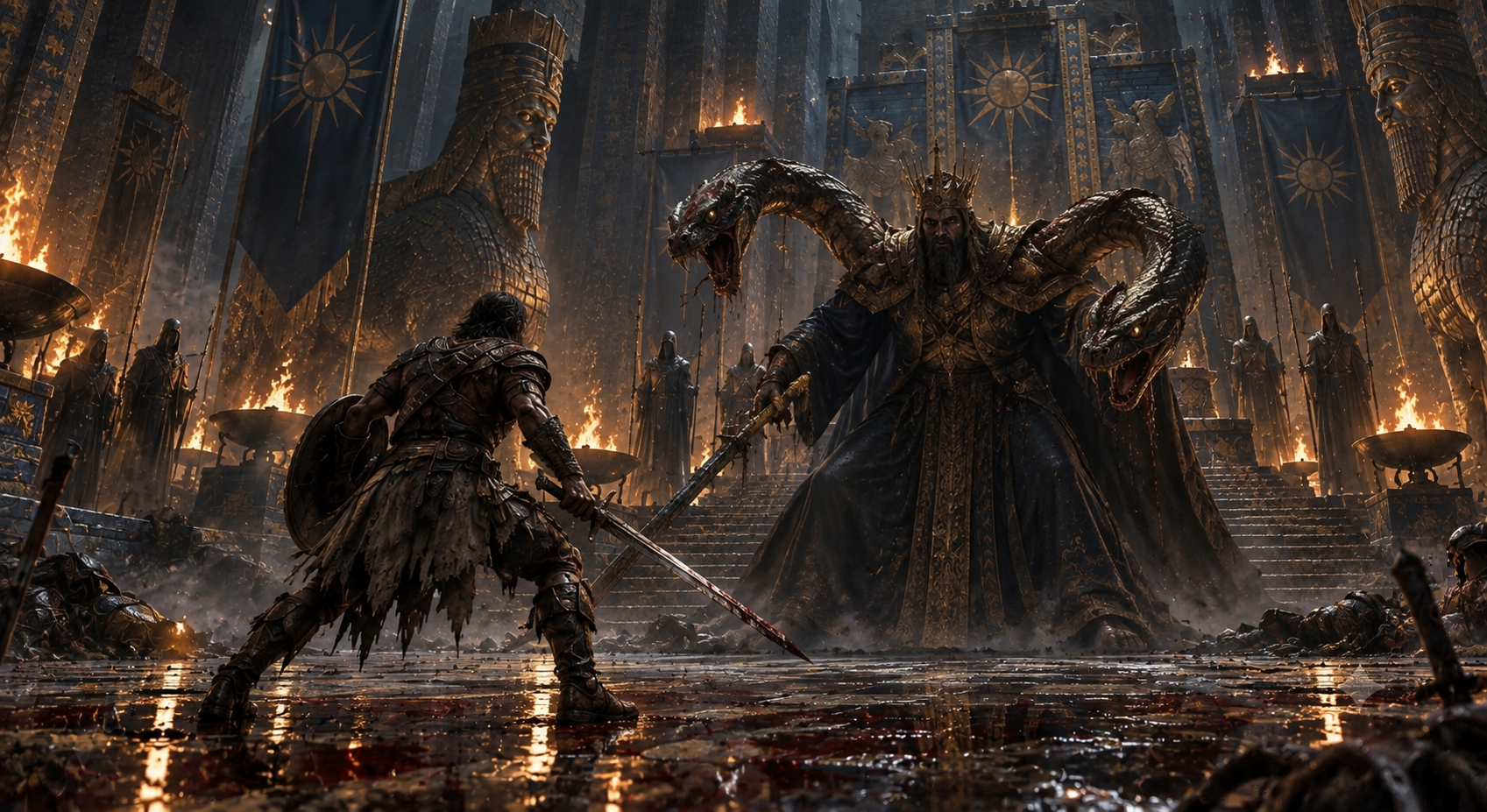
Conflicting historical sources
Decrees, murals, broken seals and architecture disagree with the court chronicle. The player constructs history from conflict between sources.
Original IP · Mythic action RPG · World bible
A condemned prisoner survives the lion pits and becomes an error in the accounting of a kingdom built to feed its king.
World premise · Lore
Blood of Babel is a third-person action RPG set in a mythic Mesopotamian kingdom. The player escapes the lion pits as an unnamed prisoner, crosses six regions shaped by the King’s sacrifices, and returns to Babel to end the curse. The journey reveals a history divided among court records, public legend and physical evidence.
The player is thrown into the lion pits beneath Babel as one more condemned nobody. The punishment fails. Escape turns an unrecorded person into a contradiction inside a kingdom obsessed with counting bodies.
The King’s curse began as a private pact. After Ibrahim survived the Great Fire, Zahak’s authority could no longer prove itself through divine obedience. The Counselor offered another kind of dominion. Two serpents fused to the King’s shoulders became the visible clause of that bargain: feed them, or they turn inward.
Criminals became enemies, enemies became forgotten people, and eventually the appetite demanded children. The horror lies in the administrative adaptation. Midwives report births. Households are counted. Lunar calendars schedule takings. Roads and kitchens are expanded. A supernatural curse becomes a normal state function.
The Veil separates human and Jinn territory. Bound Jinn enforce contracts, neutral orders defend older territories, and God-fearing Jinn reject the Counselor’s authority. Sacred geometry around the Tower, mass bloodletting and old rites can weaken the separation.
Kaveh’s rebellion applies military pressure but remains mostly outside the player’s reach. Its hammer marks, missing sons and tightened patrols shape the journey. In the ending, the player kills the King while later history credits Kaveh, the mountain or no one. Erasure completes the protagonist’s role as a person the official world could not count.
Decrees, murals, broken seals and architecture disagree with the court chronicle. The player constructs history from conflict between sources.
Road closures, guard paranoia and clandestine forges communicate Kaveh’s war without turning it into a faction questline.
Some hunt escaped assets, some enforce ancient boundaries, and some speak only when the player accepts a cost.
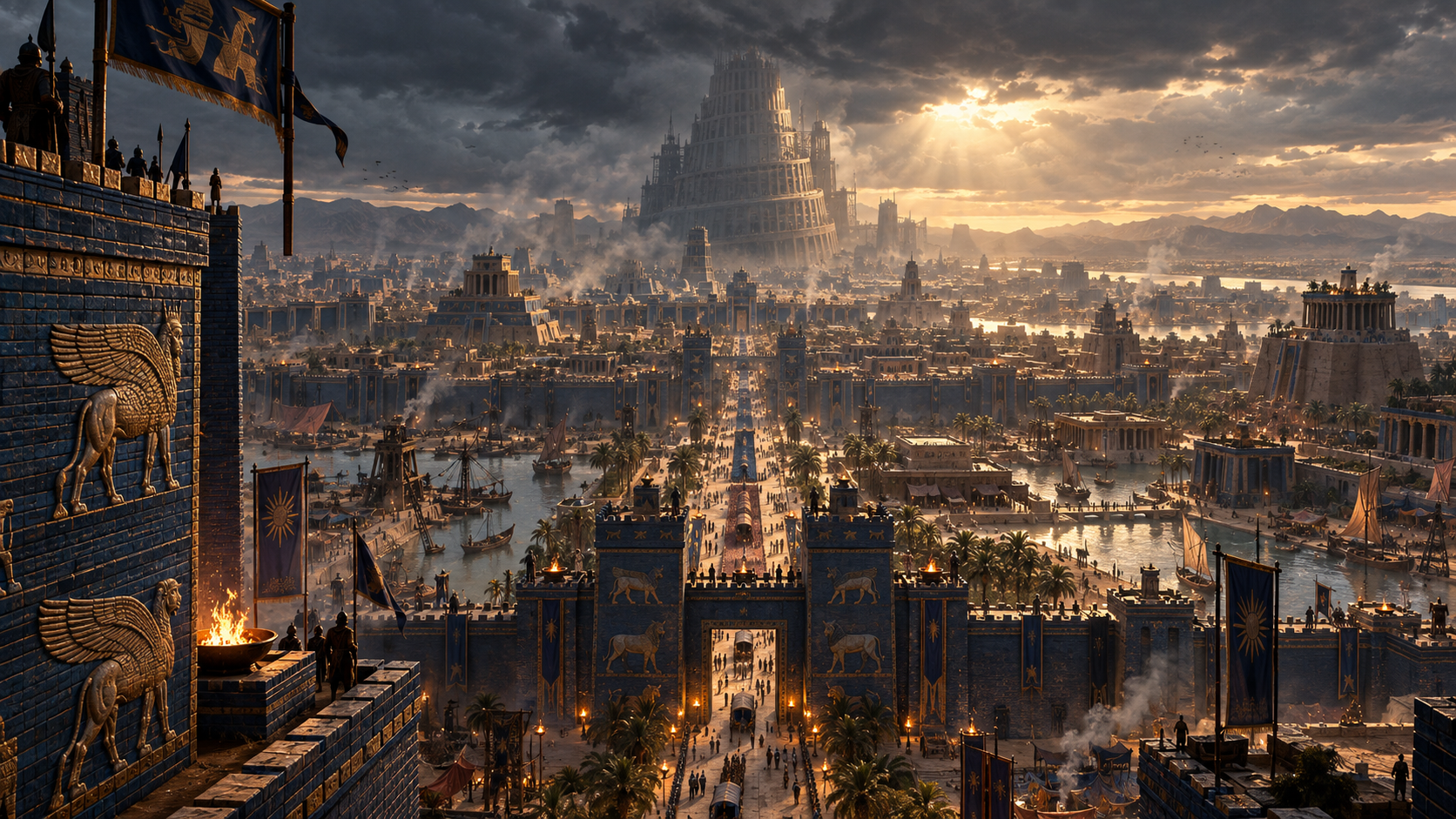
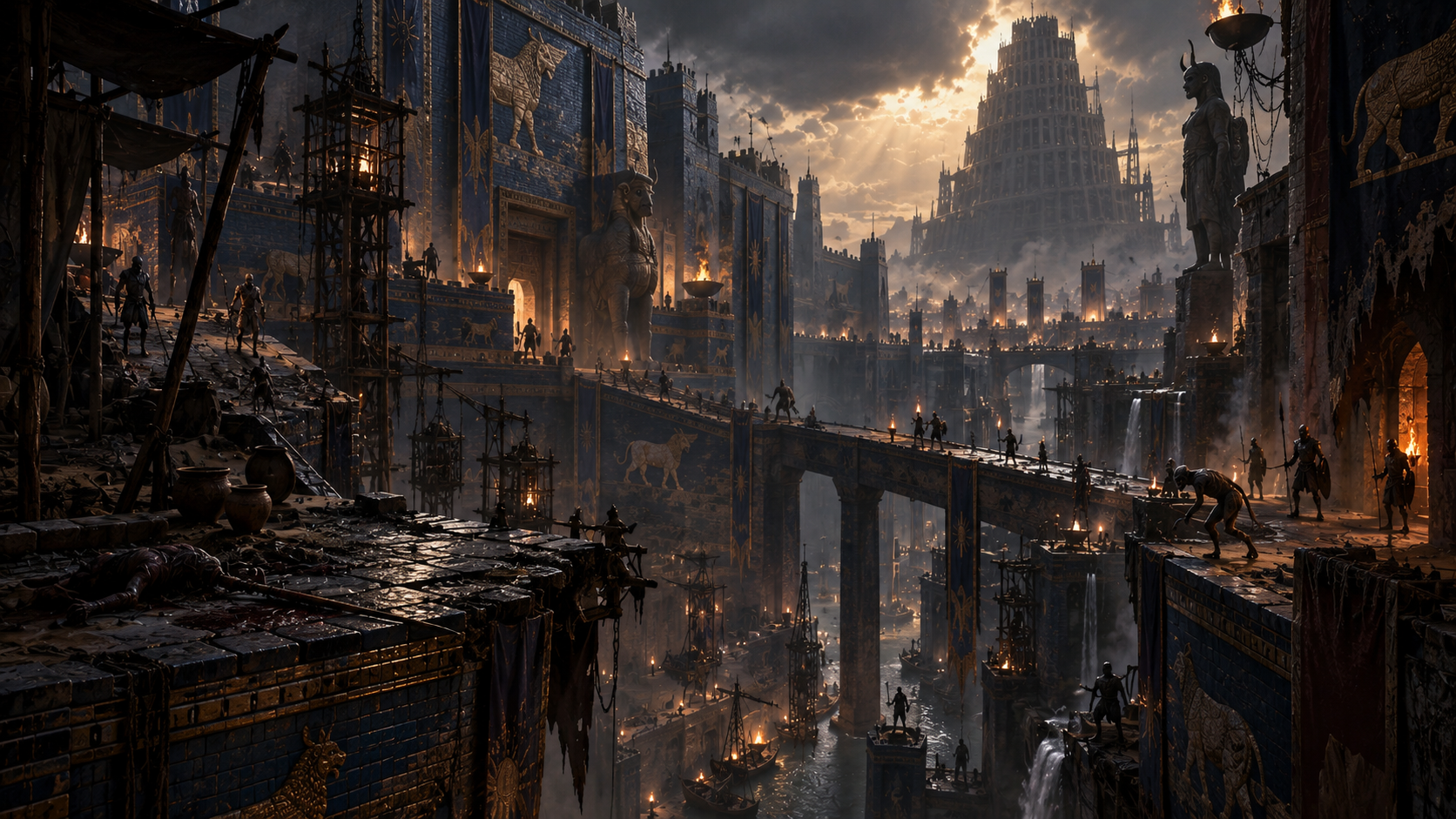
Glazed blue geometry, gold reliefs and immaculate routes make organized cruelty appear stable before its mechanism is understood.
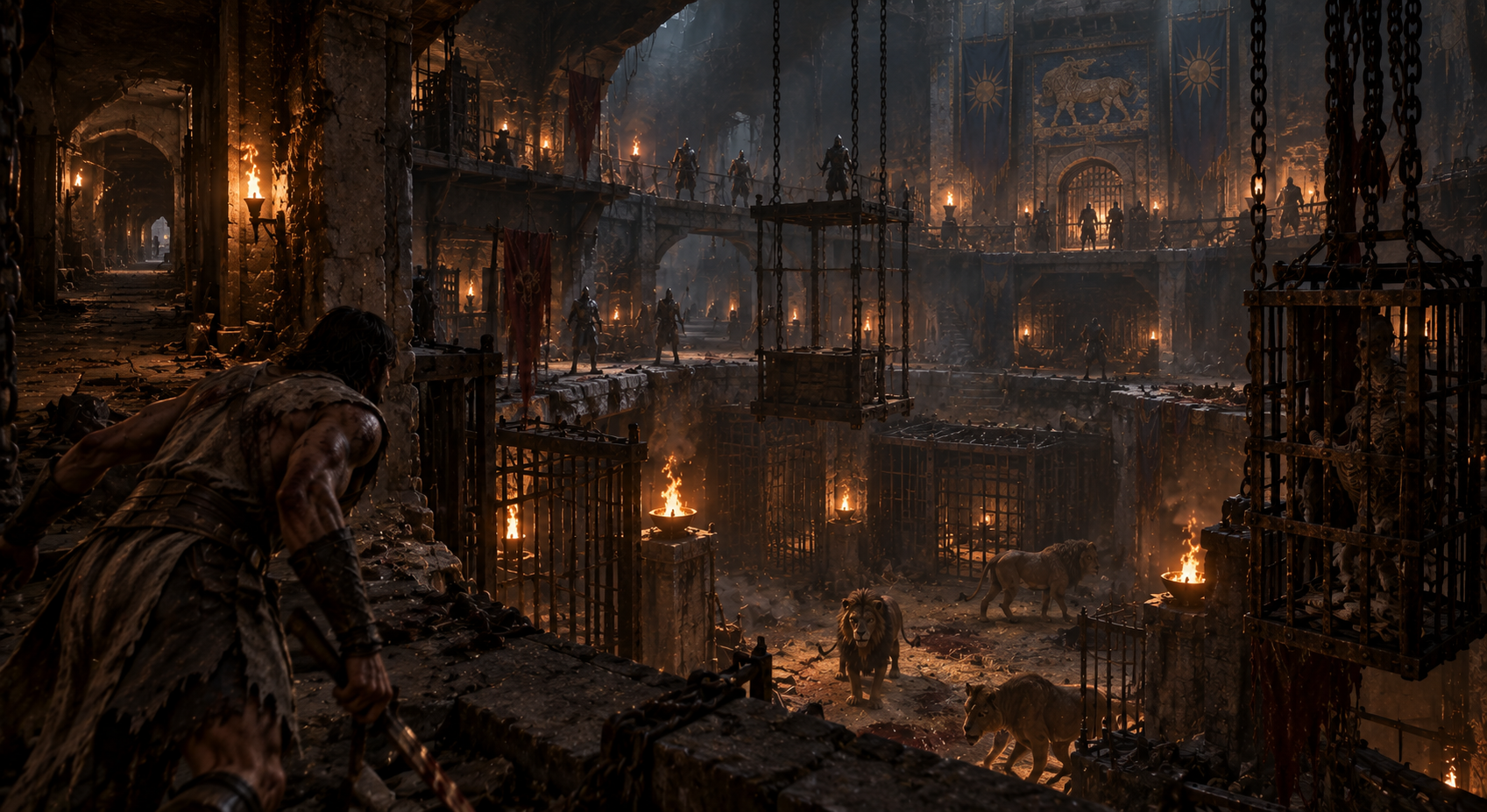
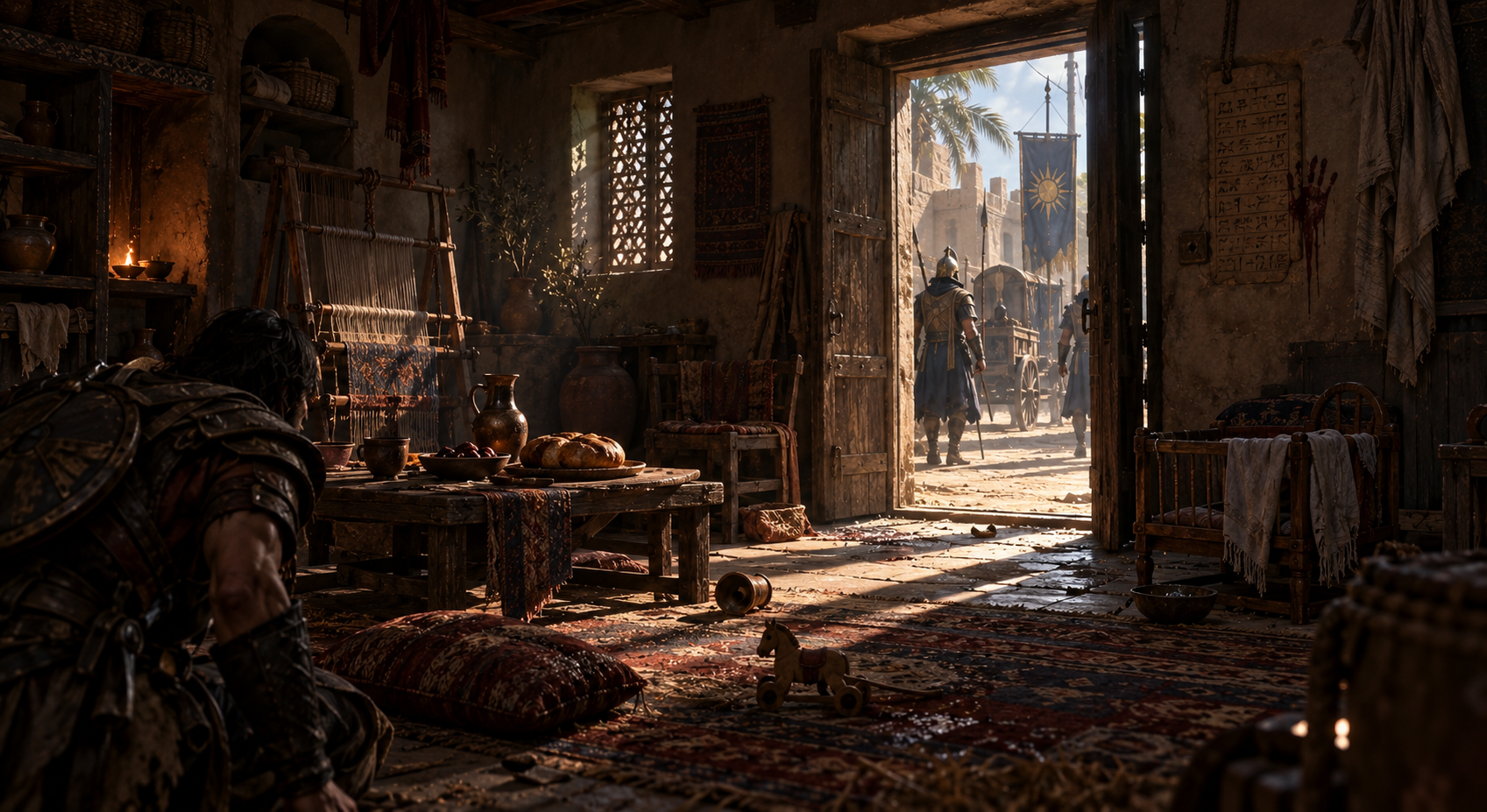
The curse reaches ordinary people through work, architecture, calendars and movement. Each region shows a different relationship between the population and the King’s demand.
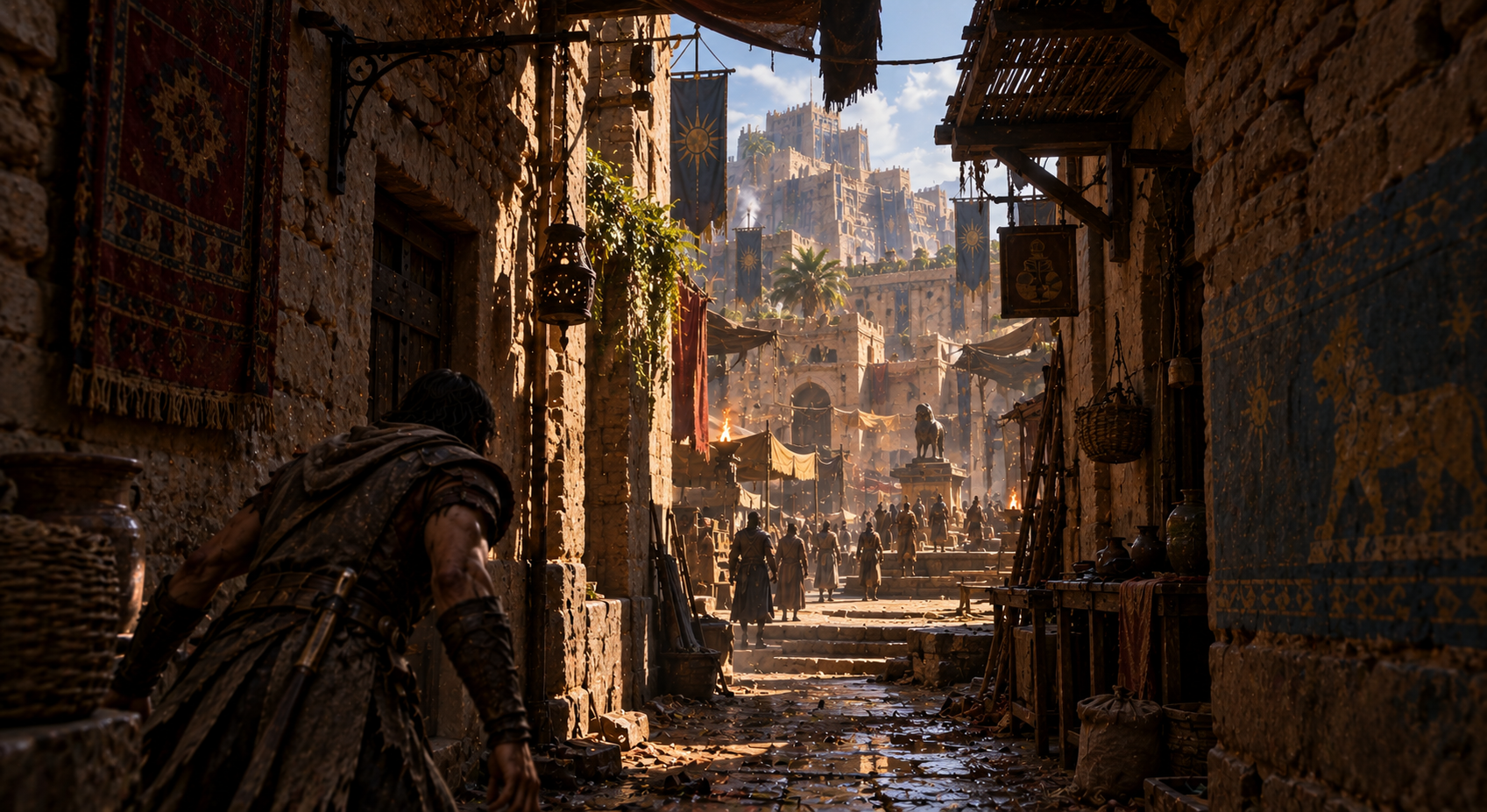
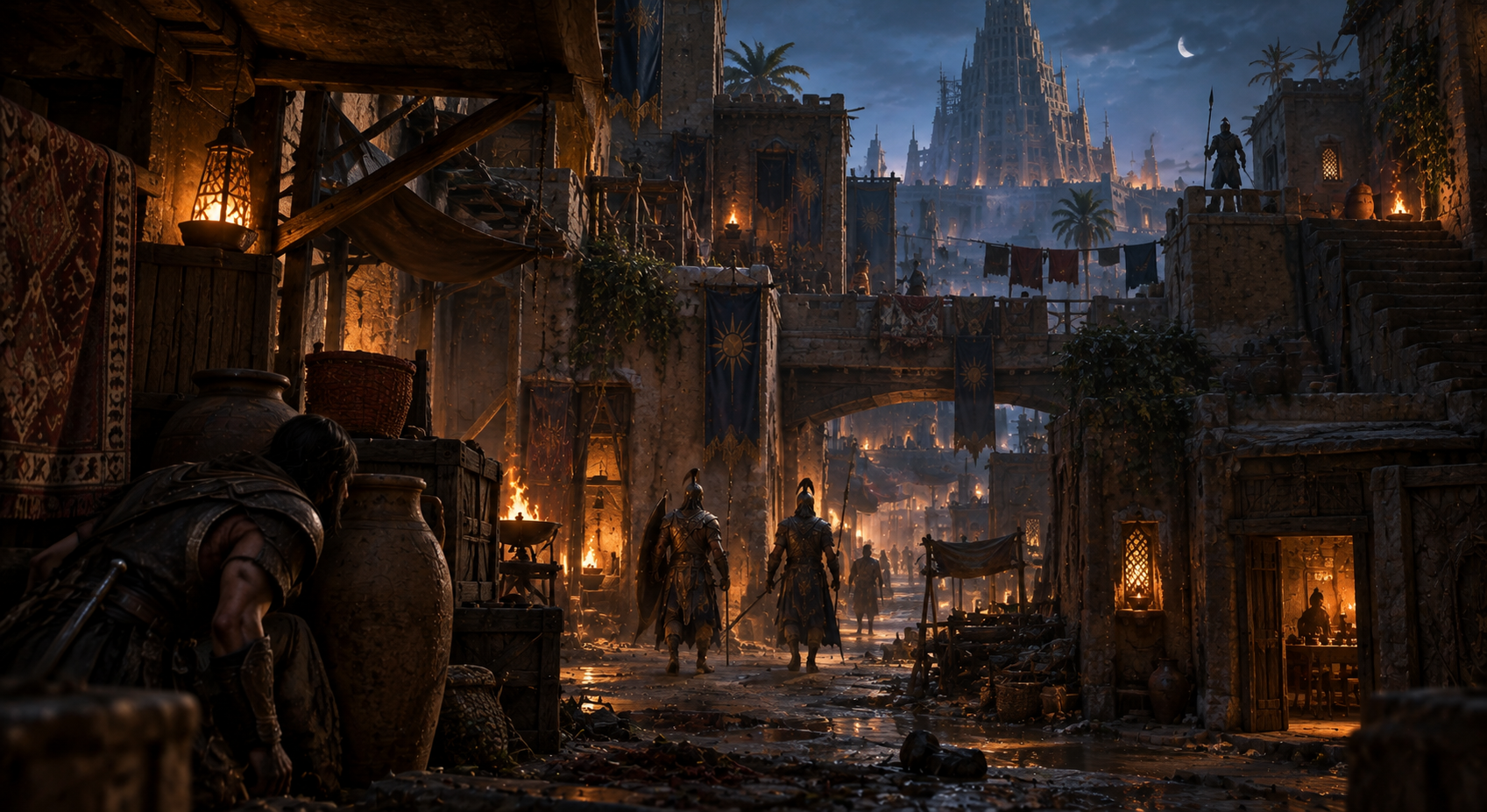
Babel remains a functioning city. Its markets, canals, temples and processional roads continue to operate while the palace consumes children through a system that most residents understand only in fragments.
Royal order is visible everywhere. Glazed blue brick, gold animal reliefs and symmetrical courtyards associate authority with beauty and permanence. The same routes used for festivals carry sealed convoys toward the palace. Court language avoids naming the sacrifice. Official records speak of takings, allocation and service to the throne.
Parents organize daily life around the risk of inspection. A closed door, a neighbor’s silence or a missing line in a birth register may become protection. Midwives hold dangerous knowledge because they know which children exist before the court does. The decree changes trust inside streets and extended families long before a convoy arrives.
Farmers manage canals, orchards, reeds and livestock under a census that connects production records to household records. Families hide newborn cries beneath running water, bribe scribes or send children toward settlements outside the main roads. Broken wagons, count stones and empty cradles show how the decree travels.
Caravan routes pass through old shrines where the Veil is thin. Desert settlements preserve practical rules for avoiding territorial Jinn. In the Zagros villages, people shelter pilgrims escaping the decree. Royal retrieval squads burn those shelters, leaving domestic objects and half-erased inscriptions to carry the history.
Public inscriptions praise the King, while additions in margins preserve names the court tried to remove. Kaveh appears through hammer marks and severed chains. Ibrahim survives as the memory of the Unburnt Pit. Several versions of the same event remain in circulation because no authority has erased them all.
Factions and powers
Political and supernatural groups are organized around the curse, the rebellion and the laws of the Veil.
Palace physicians, executioners, convoy officers and ritual kitchens maintain the King’s body. Their shared task is to keep the daily payment moving and protect the claim that his rule remains divinely legitimate.
A human uprising shaped by fathers whose sons were taken. The player encounters its symbols, road pressure and hidden forges more often than its members. Its military progress changes patrols and access across the world.
Contract spirits drawn by the Tower’s geometry and the continuing blood price. They hunt escaped assets and enforce the terms that sustain the King.
Older orders occupy deserts, mountains and buried structures. They may ignore the player until a boundary is crossed. Learning their rules becomes part of traversal.
Rare figures who reject the Counselor’s authority. They offer partial truth through riddles, exchanges and warnings while protecting their distance from human politics.
Key figures
Major figures are encountered through consequence before exposition. Their names, symbols and surviving decisions shape what the player can read in each region.
The Snake-King rules through borrowed authority that requires daily payment. Convoy remnants, kitchens, serpent reliefs and the silence around his name establish his presence before the final encounter.
A power that appears as an old man, cook or traveler. It offers kings dominion without submission and treats the curse as a contract whose terms have already been accepted.
A distant political and symbolic figure associated with lunar calendars, sealed decrees and palace images with damaged faces. Her administrative trace is clearer than her personal history.
He does not appear as an NPC. The Great Fire’s refusal to consume him survives as the Unburnt Pit and as the event that exposed the limit of the King’s authority.
The blacksmith is carried through hammer sigils, hidden forges and severed chains made into tools. His rebellion changes the roads while his name later absorbs the player’s deed.
Cosmology and metaphysics
Human and Jinn worlds once overlapped openly. The Veil created separation without peace.
Jinn withdrew toward deserts where people do not remain, mountains where breath thins, and buried cities where light cannot reach. The separation weakens around old rites, mass bloodletting and sacred geometry. The Tower therefore acts as architecture, political symbol and metaphysical wound.
Jinn remain moral agents. Bound orders enforce the King’s contract. Territorial orders protect older rules with little interest in human politics. God-fearing Jinn reject the Counselor but do not become friendly guides. A player survives these encounters by learning terms, boundaries and prices.
Historical sequence
The chronology separates the kingdom’s public history from the events the player can reconstruct through travel, architecture and conflicting records.
The King’s public claim to divine authority weakens after Ibrahim leaves the Great Fire alive.
Zahak accepts another source of dominion. The shoulder-serpents become the visible terms of the agreement.
Executions expand into household counts, scheduled takings, transport convoys and palace kitchens.
Forges, road closures and hammer marks carry the uprising from private grief into organized resistance.
An unnamed condemned person survives the lion pits and begins crossing the kingdom toward the Tower.
01 · The curse and the kingdom
The setting combines the traditions of Zahak and Nimrod into a single tyrant. His shoulder-serpents are a contract made flesh. Their daily hunger turns a private curse into roads, censuses, convoys, kitchens and law.
The Counselor offers dominion without submission.
Two living mouths bind the price to the King’s body.
Criminals no longer satisfy them. The demand shifts to children.
Birth records, takings and convoys make the payment repeatable.
Every institution is reshaped to keep one man alive.
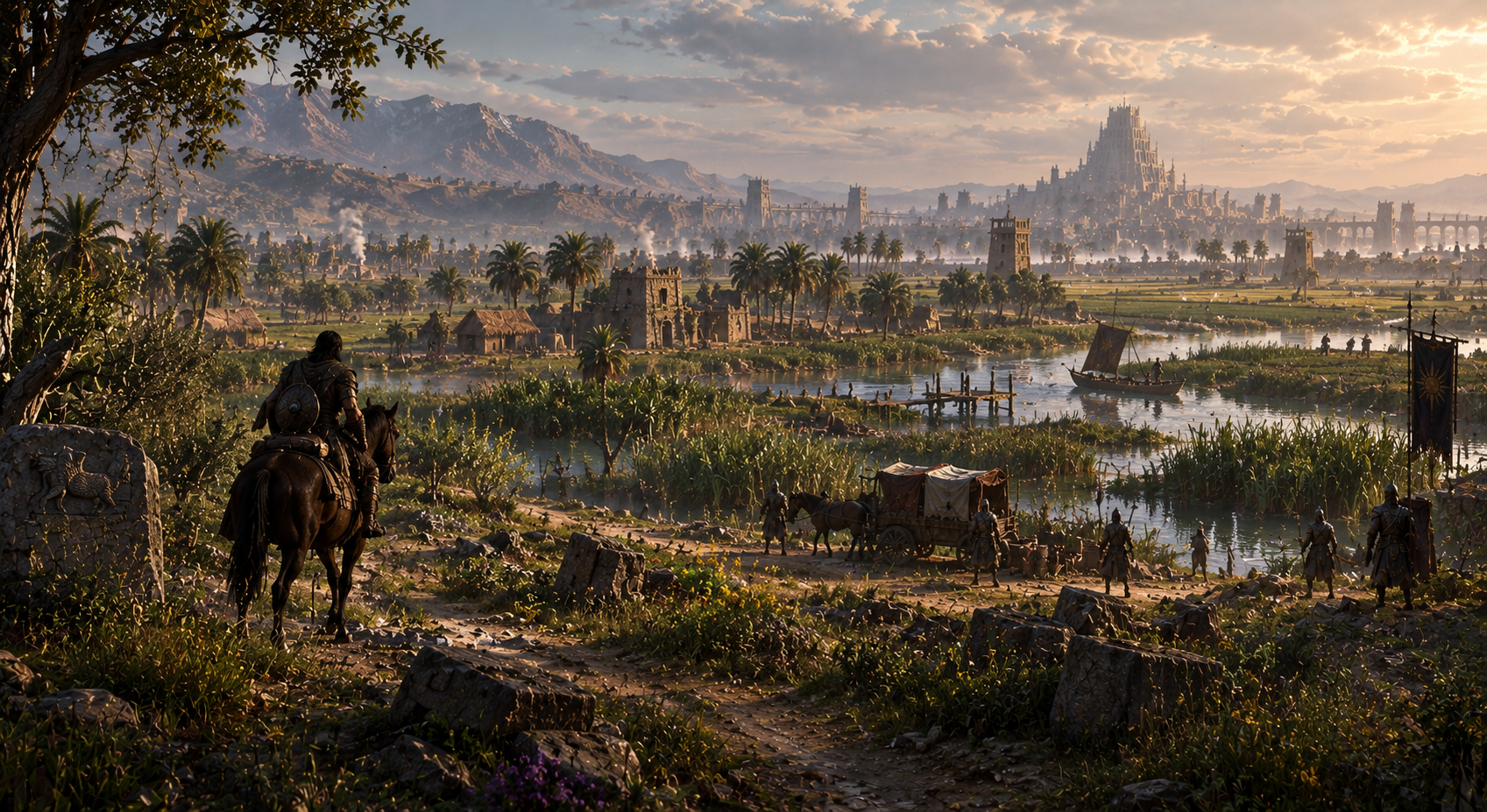
Babel was not yet a name feared beyond its fields. It was a city of canals and brick, of granaries and reed boats, ringed by low settlements that fed it with barley and goats and the labor of sunburned backs. Two great waters held the land together, one swift, one patient, and between them men learned to make green things grow where the plain wished to be dust.
The priests said the rivers were mercy. The builders said they were discipline. The merchants said they were profit. And the kings said they were proof that the heavens favored Babel.
So Babel rose.
Not in a single season, nor by a single decree, but by the slow hard will of stone. Walls thickened. Gates were widened. Processional roads were laid straight as judgment. Glazed brick, blue as deep water and bright as copper, began to appear where mud-brick had been enough before. Beasts were set into the city’s skin: lions, bulls, and dragons in relief, made to watch all who entered and remind them of order.
It was during this flowering that the boy who would become a curse was born into the royal house.
The court record names him Zahak, but the margins of later copies add other names: the Rebel, the Tower-King, Nimrod. It is written that his birth was celebrated with incense and sacrifice, yet even in the oldest lines a trembling hand notes a strange omen: the lamps in the hall burned unevenly, the dogs would not enter, and the air carried a taste of metal as if the city had bitten its own tongue.
In his youth he was praised for strength and mocked for hunger, hunger not of the stomach, but of the mind. He wanted borders to move when he commanded. He wanted the priests to speak in one voice. He wanted the gods to be measurable.
He did not want a world that could refuse him.
02 · Authority horror
Environmental evidence carries the most disturbing parts of the story. Empty registries, lunar calendars, child-sized restraints, drainage channels and broken convoy seals allow the player to reconstruct the state’s procedure.
Decrees, reliefs, architecture, remains and item fragments carry the story. Dialogue contributes local knowledge and perspective from people living inside that history.
One text credits Kaveh, another claims the mountain still holds the King, and a third implies that a nameless prisoner ended him.
Blue and gold ceremonial symmetry marks the capital. Harsh stone, punishment reliefs and militarized courts mark the border.
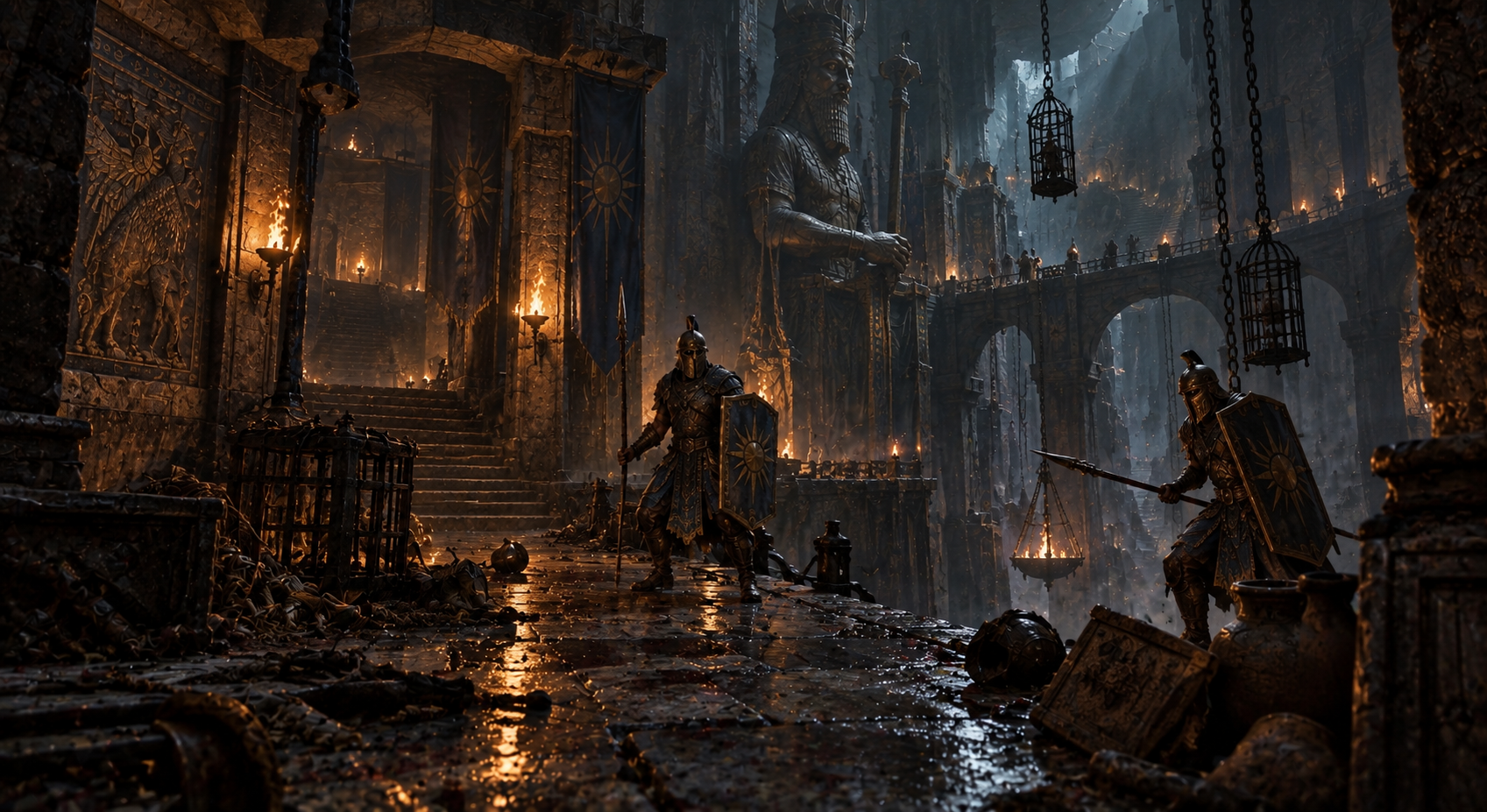
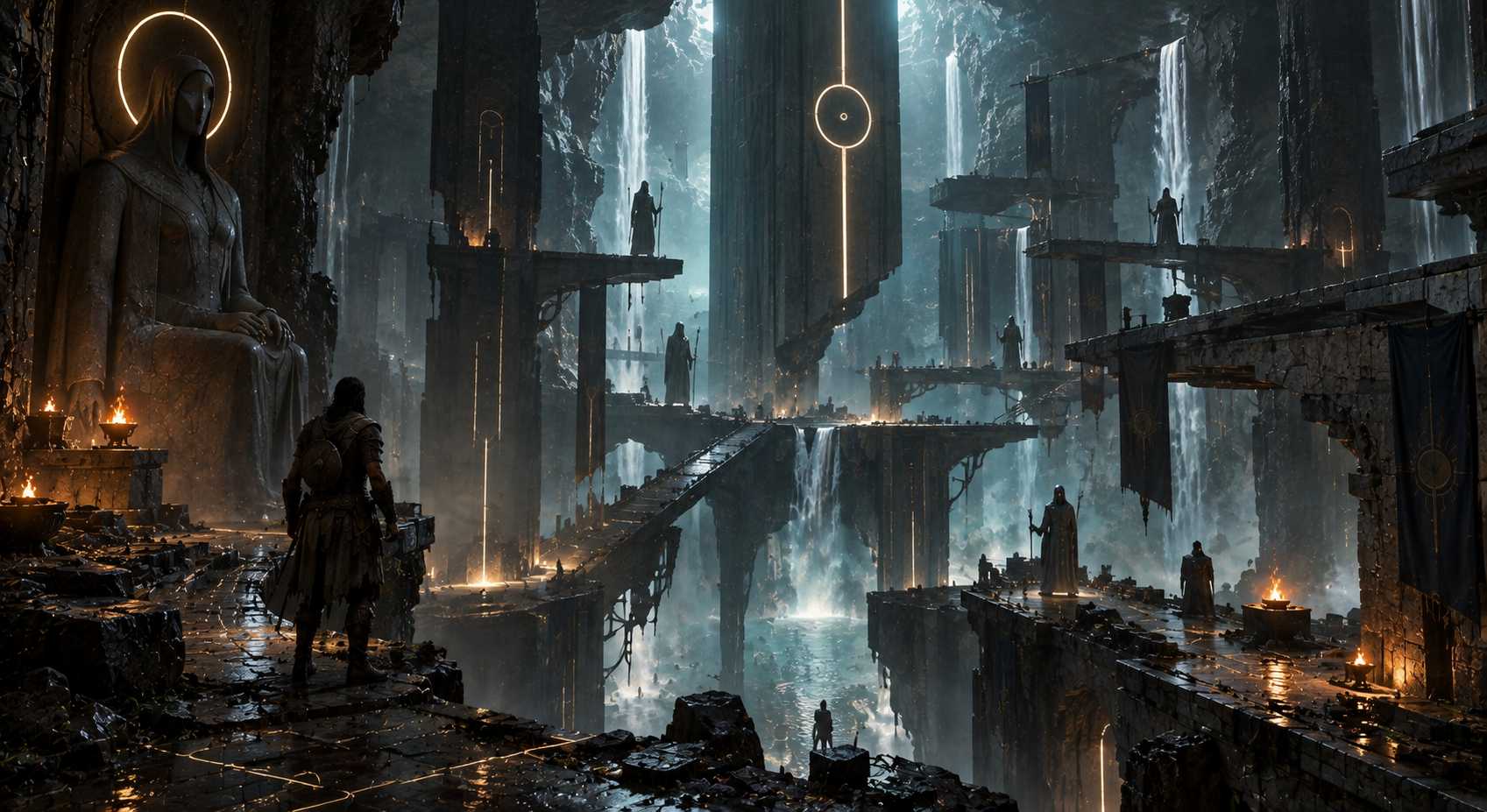
03 · Six playable regions
The route moves from procedural oppression to exile, revelation and the hidden legal order beneath human rule.
Beautiful cruelty, ritual kitchens and a Tower visible from most of the world. The player returns here for the final ascent.
Fertility strangled by accounting. Count stones, birth records and convoy roads explain the state before anyone names it.
Caravan graves and half-buried shrines introduce territorial Jinn and show that not every non-human presence is an enemy.
Frozen inscriptions preserve laws older than Babel. Hard travel becomes the condition for learning how contracts and the Veil operate.
Black iron stakes and the Pact Cave fracture the public legend. The player learns what can bind a tyrant before returning to kill him.
An older bureaucracy beneath the human one. Neutral officials ignore the player until a rule is broken; corrupted litigators punish unauthorized existence.

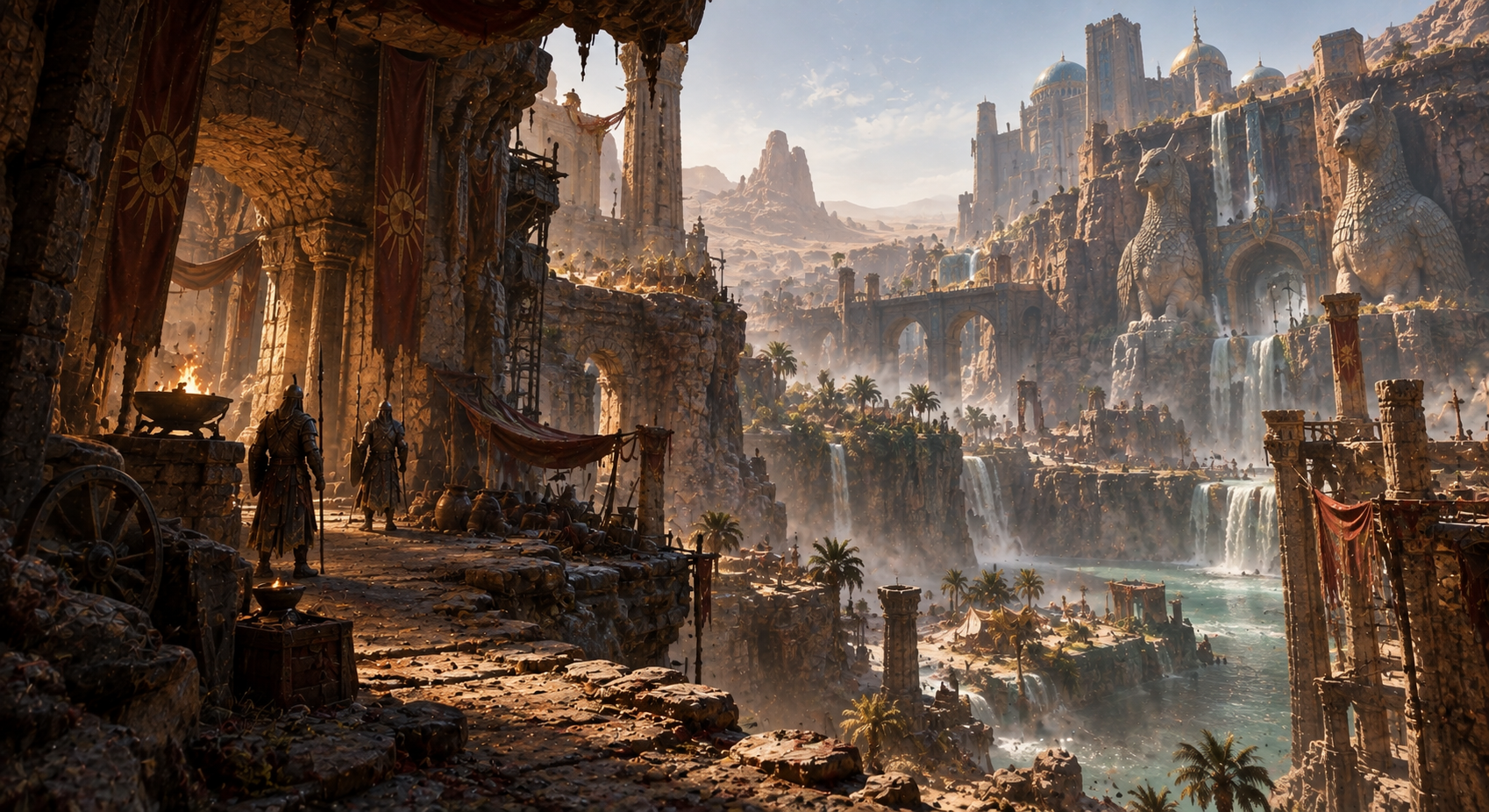
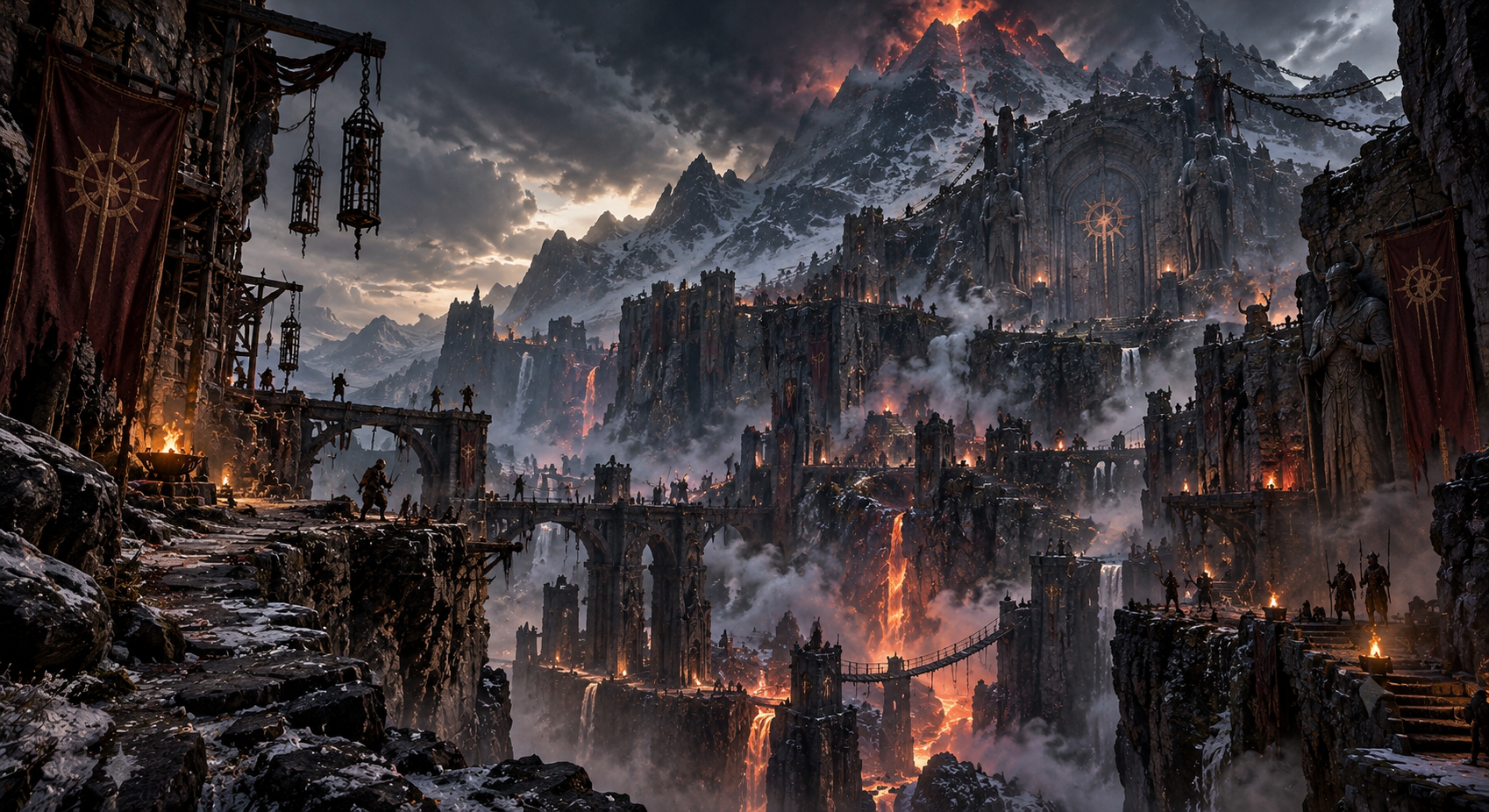

Under-Babel · Pre-human geometry designed to feel legal rather than ornamental
04 · Narrative architecture
The opening begins in the lion pits. Surviving makes the protagonist a living accounting error, pursued first as escaped property and later as a threat to the story the kingdom tells about itself.
Bound Jinn enforce contracts, neutral Jinn defend old territory, and God-fearing Jinn offer truths at a price without becoming quest givers.
Hammer marks, hidden forges, severed chains and tightened patrols create a distant war. The player crosses its pressure without joining a faction campaign.
The player performs the final act, but later records disagree. Kaveh receives the legend while the nameless prisoner disappears from official memory.
Original concept, chronicle, cosmology, six-region structure, factions, environmental narrative rules and game progression by Hamza Trabelsi. Concept imagery is AI-assisted visual development.